how does choose the carbide saw blade
Jul 26, 2022
Carbide saw blades are the most commonly used cutting tools for wood product processing. The quality of carbide saw blades is closely related to the quality of processed products. The correct and reasonable selection of cemented carbide saw blades is of great significance for improving product quality, shortening processing cycles, and reducing processing costs. Carbide saw blades include many parameters such as the type of alloy cutter head, the material of the base body, diameter, number of teeth, thickness, tooth shape, angle, aperture, etc. These parameters determine the processing capacity and cutting performance of the saw blade. When choosing a saw blade, it is necessary to correctly select the saw blade according to the type, thickness, sawing speed, sawing direction, feeding speed and sawing width of the sawing material. So how does it choose?
(1) Selection of cemented carbide types
Commonly used types of cemented carbide are tungsten-cobalt (code YG) and tungsten-titanium (code YT). Due to the good impact resistance of tungsten-cobalt carbide, it is more widely used in the wood processing industry. The models commonly used in wood processing are YG8-YG15. The number after YG indicates the percentage of cobalt content. With the increase of cobalt content, the impact toughness and flexural strength of the alloy are improved, but the hardness and wear resistance are decreased. Choose according to the actual situation.
(2) The choice of substrate
1. 65Mn spring steel has good elasticity and plasticity, economical material, good hardenability in heat treatment, low heating temperature, easy deformation, and can be used for saw blades that do not require high cutting requirements.
2. Carbon tool steel has high carbon content and high thermal conductivity, but its hardness and wear resistance drop sharply when subjected to a temperature of 200 ° C - 250 ° C, the heat treatment deformation is large, the hardenability is poor, and the tempering time is long and easy to crack. Manufacture economical materials for cutting tools such as T8A, T10A, T12A, etc.
3. Compared with carbon tool steel, alloy tool steel has better heat resistance, wear resistance and better handling performance. The heat distortion temperature is 300℃-400℃, which is suitable for manufacturing high-grade alloy circular saw blades.
(3) Choice of diameter
The diameter of the saw blade is related to the sawing equipment used and the thickness of the workpiece to be sawed. The diameter of the saw blade is small, and the cutting speed is relatively low; the larger the diameter of the saw blade, the higher the requirements for the saw blade and the sawing equipment, and the higher the sawing efficiency. The outer diameter of the saw blade is selected according to the different circular saw models to use the saw blade with the same diameter.
(4) Selection of the number of teeth
Generally speaking, the more teeth there are, the more cutting edges can be cut in a unit time, and the better the cutting performance is. However, the more the number of cutting teeth, the more cemented carbide is needed, and the price of the saw blade is high, but the teeth are too dense. , the amount of chips between the teeth becomes smaller, which is easy to cause the saw blade to heat up; in addition, there are too many saw teeth, and if the feed amount is not properly matched, the cutting amount of each tooth is very small, which will aggravate the friction between the cutting edge and the workpiece and affect the service life of the cutting edge. . Usually the tooth spacing is 15-25mm, and a reasonable number of teeth should be selected according to the material to be sawed.
(5) Selection of tooth shape
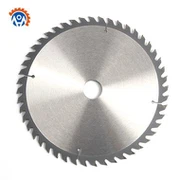
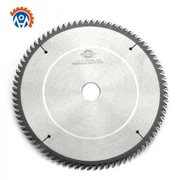
Commonly used tooth shapes are left and right teeth (alternating teeth), flat teeth, trapezoidal flat teeth (high and low teeth), inverted trapezoidal teeth (inverted conical teeth), dovetail teeth (hump teeth), and the rare industrial grade three. Left-right, left-right, left-right, flat-tooth, etc.
1. The left and right teeth are the most widely used, with fast cutting speed and relatively simple grinding. It is suitable for cutting and cross sawing various soft and hard solid wood profiles and MDF, multi-layer boards, particle boards, etc. The left and right teeth equipped with anti-rebound force protection teeth are dovetail teeth, which are suitable for longitudinal cutting of various boards with tree knots.
The left and right tooth saw blades with negative rake angle are usually used for sawing veneer due to sharp teeth and good sawing quality.
2. The flat tooth saw edge is rough, the cutting speed is slow, and the grinding is the easiest. It is mainly used for sawing of common wood, and the cost is low. It is mostly used for aluminum saw blades with smaller diameters to reduce adhesion during cutting, or for grooving saw blades to keep the bottom of the groove flat.
3. Ladder flat tooth is a combination of trapezoidal tooth and flat tooth. Grinding is more complicated. When sawing, it can reduce the phenomenon of veneer cracking. It is suitable for sawing of various single and double veneer wood-based panels and fireproof panels. In order to prevent sticking of aluminum saw blades, saw blades with a large number of flat teeth are often used.
4. Inverted ladder teeth are often used in the bottom groove saw blade of panel saw. When sawing double-veneer wood-based panels, the groove saw adjusts the thickness to complete the grooving process of the bottom surface, and then the main saw completes the sawing process of the board, so that the Prevent the saw edge from chipping.
To sum up, the left and right teeth should be selected for sawing solid wood, particleboard and medium density board, which can sharply cut the wood fiber structure and make the incision smooth; in order to keep the groove bottom flat, use the flat tooth profile or the left and right flat teeth. Combination teeth; Ladder flat teeth are generally selected for sawing veneer and fireproof board. Due to the large sawing rate, the diameter and thickness of the alloy saw blade used in the computer sizing saw are relatively large, with a diameter of about 350-450mm and a thickness of 4.0-4.8 Between mm, most of the flat teeth are used to reduce chipping and saw marks.
(6) Choice of aperture
The aperture is a relatively simple parameter, which is mainly selected according to the requirements of the equipment, but in order to maintain the stability of the saw blade, it is better to use a larger aperture for the saw blade above 250MM. At present, the diameters of standard parts designed in China are mostly 20MM holes with diameters of 120MM and below, 25.4MM holes with diameters of 120-230MM, and 30 holes with diameters above 250. Some imported equipment also have 15.875MM holes, and the mechanical hole diameter of multi-blade saws is relatively complex. , more with keyway to ensure stability. Regardless of the size of the hole, it can be transformed by a lathe or a wire cutting machine. The lathe can be turned into a large hole with a washer, and the wire cutting machine can ream the hole as required by the equipment.
A series of parameters such as the type of alloy cutter head, the material of the base body, diameter, number of teeth, thickness, tooth shape, angle, and aperture are combined into the whole of the carbide saw blade. Only reasonable selection and matching can make better use of its advantages.